Project Overview: Forest Health Assessment at Wildwood Park
|
In fall 2018, students in Radford University's Forest & Wetland Ecology (BIOL 476), with Dr. Christine Small, conducted a forest health assessment of Wildwood Park in Radford, Virginia. This roughly 50 acre natural area includes steep east- and west-facing slopes connected by Connelly’s Run, a large stream. Our primary goals were to identify major forest types, dominant trees and shrubs, and associated environmental site conditions across the park. Twelve 400 m² sample plots were established in natural habitats of Wildwood Park to examine forest structure, species, site environment, and potential disturbance impacts. Our vegetation sampling and field methods were based on Virginia DCR Natural Heritage and The Carolina Vegetation Survey (Peet et al. 1998) protocols for vegetation data collection. U.S. National Park Service monitoring protocols also were used to assess the status of forest plant communities and evaluate potential threats to forests at Wildwood Park. These "Vital Signs" are used as indicators of ecosystem health in parks across North America. Potential threats investigated in forests at Wildwood Park included: invasive plants, insect pests and fungal pathogens, white-tailed deer herbivory, forest mesophication, and potential climate change influences. |
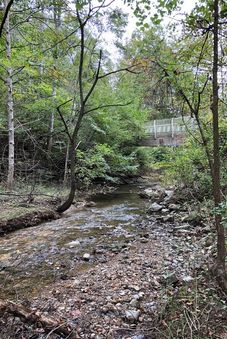
Connelly's Run and adjacent floodplain at Wildwood Park
|
|
Based on our vegetation surveys, four major forest types were identified at Wildwood Park:
|
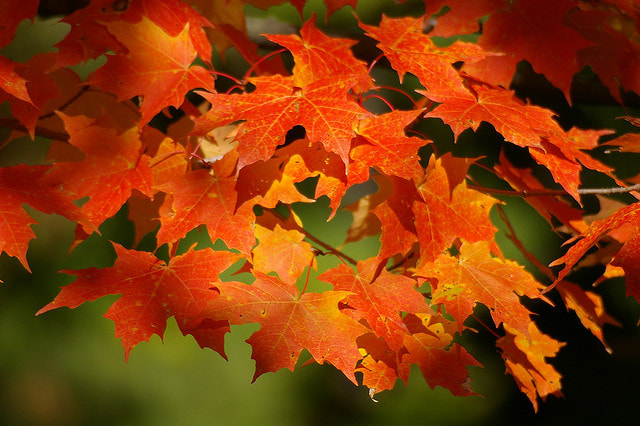
Sugar Maple (Acer sacharrum)
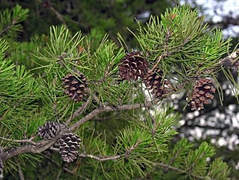
Virginia Pine (Pinus virginiana)
|
.jpg)
Japanese barberry (Berberis thunbergii)
|
Invasive shrubs pose the greatest threat to moist forest communities at Wildwood Park.
Amur honeysuckle and Morrow's honeysuckle occurred in nearly all mixed-mesophytic and floodplain plots, and garlic mustard, wineberry, and multiflora rose also were common in these moist forests. Drier forests seemed more resistant to invasive plant species, except for Japanese barberry, an invasive shrub common in dry-mesic oak forests. |
|
As a class, we found the first signs of the Emerald Ash Borer, an invasive exotic insect pest likely to cause severe declines in white ash and green ash trees at Wildwood Park. This vital sign is imperative in our forests because it could cause the change in forest type as the ash tree begins to disappear.
At Wildwood Park, some forests also appear to be shifting towards more "mesophytic" forest communities. This is most pronounced in dry mesic oak forests, where red oak appears only as large canopy trees; these oaks are likely to be replaced by sugar maple, the most common tree in the regeneration layer, in the future. Climate change also threaten forests at Wildwood Park. Floodplain forests, mixed-mesophytic forests, and dry calcareous forests and woodlands appear to be most vulnerable to climate change impacts. 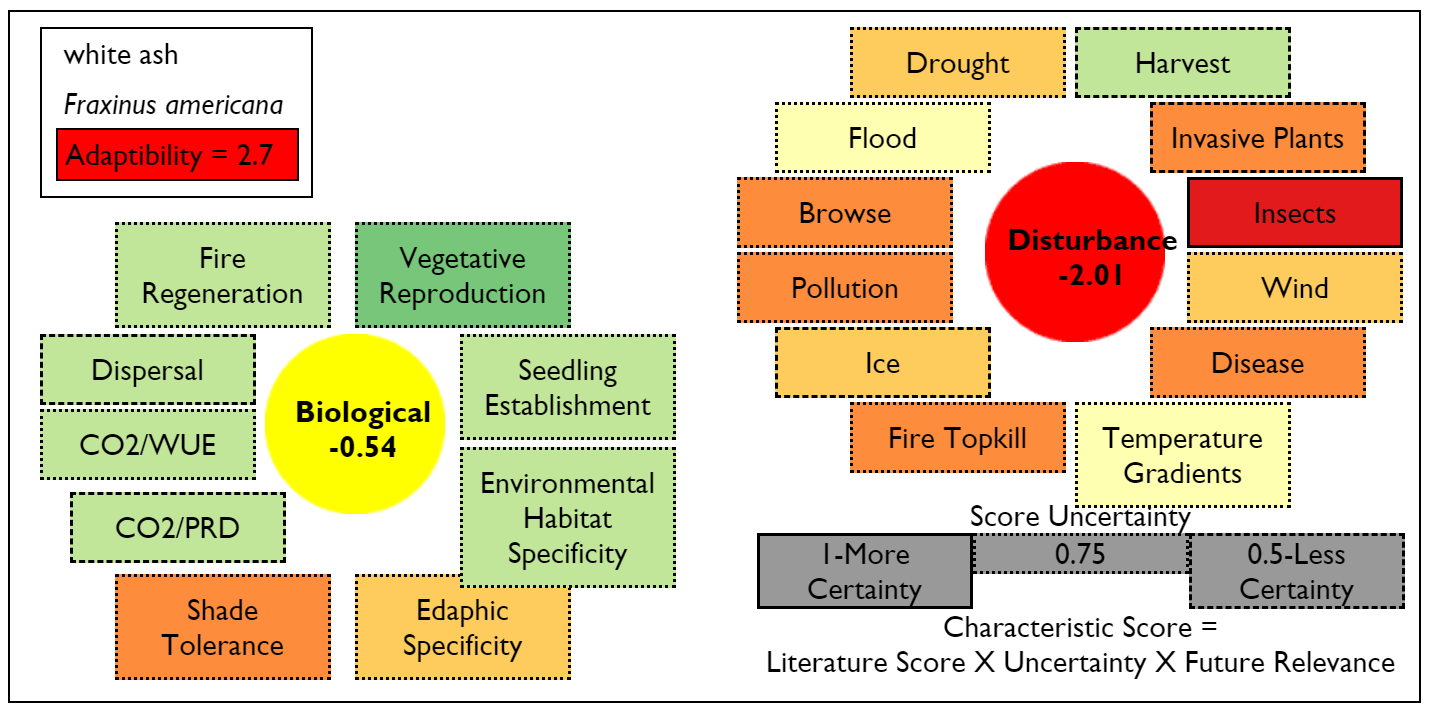
Predicted adaptability of white ash to climate change (USDA Forest Service Climate Change Atlas)
|
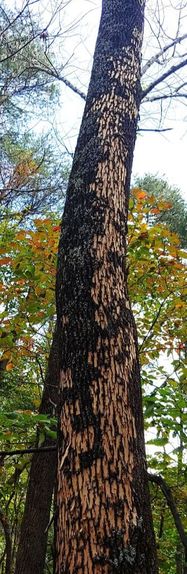
Emerald ash borer damage at Wildwood Park
|
OVERVIEW VITAL SIGNS RESEARCH METHODS FOREST TYPES DISTURBANCE IMPACTS

|
